
A seawall’s age alone doesn’t determine whether to repair or replace it. The long-term cost of seawall ownership depends on the wall’s structural…
A seawall’s age alone doesn’t determine whether to repair or replace it. The long-term cost of seawall ownership depends on the wall’s structural condition, how far damage has progressed, and how consistently it’s maintained. Localized problems may be repairable, while widespread movement or soil loss can point to replacement.
It’s understandable to focus on the immediate work, but a short-term fix may leave underlying erosion untouched, while replacement means rebuilding the structure. Compare options by looking beyond the next repair to the wall’s remaining service life and the risks to the shoreline and property.
This article explains how condition, repair-versus-replacement decisions, lifespan, and routine maintenance shape ownership costs over time. It also considers how a seawall’s condition can affect property value and buyers’ perceptions when a waterfront home is sold. The goal is to give you a clear basis for weighing options, not a one-size-fits-all rule.
The cost difference starts with the source of the damage. Targeted repairs that fill voids and stabilize soil can address early erosion behind the wall. Surface patching covers visible defects but doesn’t stop soil loss or correct movement. If deterioration extends through the structure, replacement means rebuilding rather than treating isolated areas. The scope depends on the wall’s condition, material, access, and site conditions.
The repair method should suit the wall’s structural capacity. A polymer-modified overlay or shotcrete can extend the life of a structurally intact concrete surface by five to ten years. These treatments don’t restore a wall that has shifted or lost support. An overly aggressive two-component fill can damage a wall with limited capacity or significant movement, potentially blowing it out. Corrosion, cracking, and soil loss require different assessments, so repairs should address the cause, not just the visible symptom.
Localized repairs are appropriate for isolated damage when the surrounding wall remains stable. A crack or leaking joint may need focused work, while a growing void behind the wall calls for soil stabilization. Large voids, extensive movement, or widespread structural failure can make replacement more appropriate. Cosmetic patching may improve the surface, but it can leave underlying erosion active and add to future work.
Service life matters as much as the first repair. Seawall repairs are described as lasting 3 to 10 years, while repeated fixes rarely extend total life beyond 15 years from the first major repair. A replacement is described as lasting 30 to 75 years, depending on conditions. That difference can change the long-term cost of seawall ownership, even when replacement requires more work upfront.
Are grants, tax incentives, or cost-sharing programs available for seawall repairs and coastal resilience? Programs vary by location and project purpose, so no single grant or tax incentive applies broadly to every residential seawall. Potential support may depend on local eligibility rules, ownership, and whether the project serves a wider resilience goal.
Compare the repair scope with the wall’s structural condition, exposure, and the work required for replacement. The right option depends on what is failing and how much of the structure remains sound.
Cost per linear foot divides a project estimate by the seawall’s length, helping compare work on walls of different sizes. Repair costs vary with the defect and method, while replacement involves rebuilding the structure and may include removing the old wall. Compare complete scopes, including access, disposal, foundation work, and installation, rather than relying on a single per-foot figure.
A common rule of thumb is to consider replacement when repairs would cost 50% or more of a new wall. Treat that as a comparison point alongside structural condition and expected service life.
Wall length helps establish project scale, but the type of damage determines the work needed. A small area of joint deterioration differs from widespread leaning, failed toe protection, or soil loss behind the wall. Each condition calls for a distinct repair approach, and a longer affected section can increase the labor and materials required.
Compare estimates for the same length and scope. One may include soil stabilization, while another addresses only visible surface damage.
Strong wave action and ongoing erosion place extra demands on a seawall’s structure and foundation. Soil conditions, water depth, site access, and boat traffic can all affect project complexity. These factors matter for both repairs and replacement because the work must address the forces affecting the wall, not simply restore its appearance.
Environmental exposure also informs material and construction choices. A surface-only fix may leave the cause of damage in place, while a more extensive project may require additional site work.
Living shorelines, revetments, and seawalls offer different forms of shoreline protection, so their costs depend on site conditions and project goals. Living shorelines use natural features, while revetments use sloped protective material. The cost to build a seawall in the United States also varies with length, material, access, and exposure.
Compare maintenance needs, shoreline function, and installation scope, not just initial project estimates. Review the project scope as part of choosing an approach.
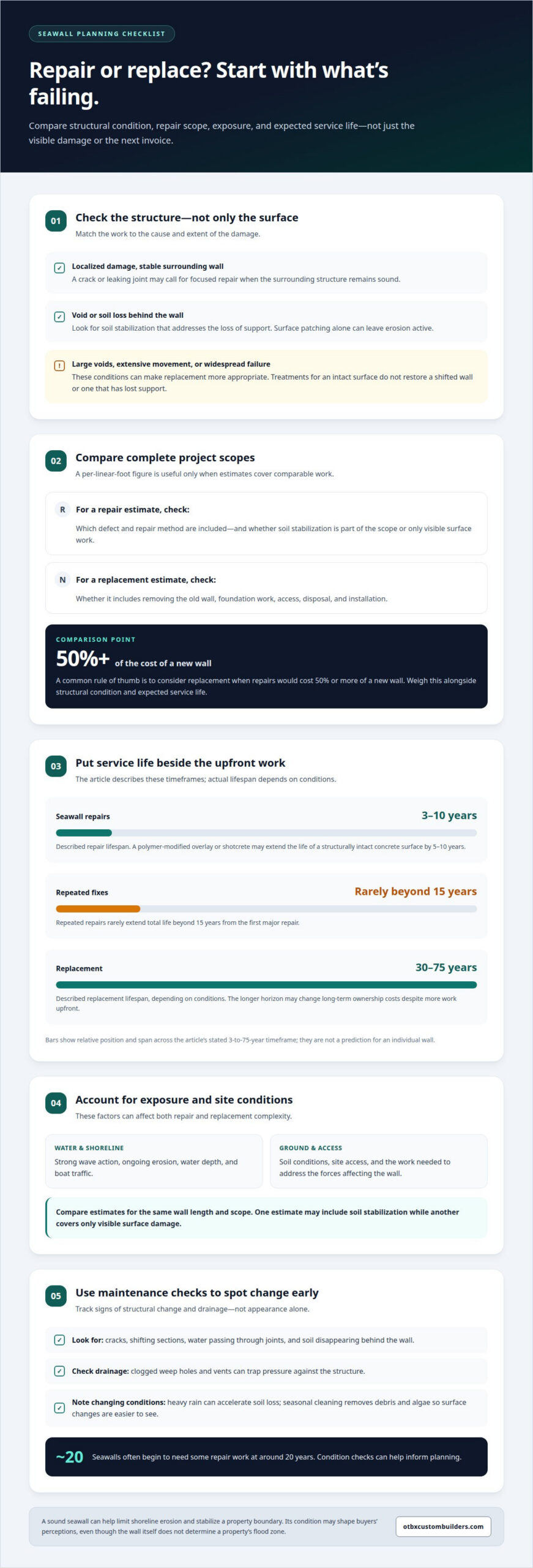
A sound seawall helps limit shoreline erosion and stabilize a property boundary. That protection matters where soil loss could undermine yards, paths, or nearby structures. A seawall’s condition can also influence buyers’ perceptions of a waterfront property, even though the wall itself doesn’t determine its flood zone. Visible cracks, movement, or neglected drainage may prompt questions about maintenance and future work.
Maintenance focuses on early signs of change, not appearance alone. Regular inspections can identify cracks, shifting sections, water passing through joints, or soil disappearing behind the wall. Heavy rain can accelerate soil loss, while clogged weep holes and vents can trap pressure against the structure. Seasonal cleaning removes debris and algae, making surface changes easier to see. Seawalls often begin to need some repair work at around 20 years, so condition checks can help inform planning.
Capital-project planning turns those observations into a clear scope. Record the wall’s condition, affected linear sections, access constraints, and likely cause of damage. An estimate should distinguish surface work from structural repairs and state whether soil stabilization or replacement is being considered. Permitting requirements vary by location and project, so include the relevant approval process in your planning. Site conditions and the extent of work also shape the construction approach.
Build maintenance into property stewardship instead of waiting for visible movement. After storms or heavy rain, note new cracks, unusual drainage, or depressions behind the wall. Keep weep holes clear and remove seasonal debris before it blocks drainage. If a section starts leaning or water carries soil through a joint, arrange an assessment and address the cause. These steps create a useful record for future repair decisions and capital planning.
Responsibility depends on where the seawall sits, who owns the land beneath it, and whether recorded agreements assign maintenance duties. A wall beside public land isn’t automatically a public asset, just as a wall between two yards isn’t automatically shared. The visible boundary alone may not settle ownership. A property survey, deed, easement, or maintenance agreement can help clarify the arrangement.
For a wall between neighboring properties, establish whether it lies entirely on one parcel or serves both. A shared structure may protect two yards, but that alone doesn’t determine how costs or upkeep are divided. Review property documents for written terms, then document the affected wall section and proposed work. For example, a repair limited to one property’s side may still involve a structure supporting land on both sides.
Public-land boundaries add another layer. A seawall near a park, road, or public shoreline may sit on private land, public land, or an easement. That arrangement can affect who can authorize access and construction. Clarify the boundary and any applicable agreement with the relevant landowner or public authority before work begins. Permitting and access requirements also shape the project, but don’t by themselves establish who owns or maintains the wall.
Separate three questions: who owns the wall, who can approve work, and who pays for it. Keep survey records, agreements, inspection findings, and repair estimates together. If neighbors share responsibility, a written scope can specify the work area, access, cost allocation, and maintenance expectations. For public boundaries, include the responsible authority in project coordination before setting a construction schedule. These steps can reduce disputes and delays caused by unclear ownership.
For a seawall condition assessment and repair scope, contact OTBX Custom Builders, LLC.
OTBX Custom Builders provides seawall construction and repair for property owners weighing targeted work against a larger rebuild. Turn to this service when cracks, soil loss, leaning, or other visible changes raise questions about the wall’s condition and the right project scope. Repair planning should distinguish surface defects from problems affecting structural support, then match the work to the site and seawall.
A clear scope connects immediate work with long-term ownership needs. It can identify affected areas, the type of repair or construction involved, and how the seawall fits the surrounding waterfront. If the property also includes a dock, coordinated planning can account for both structures. OTBX Custom Builders also provides New Home Construction, including custom homes and stick-built homes.
To discuss your seawall project, contact OTBX Custom Builders.
A practical way to manage the long-term cost of seawall ownership is to make the next decision with a defined scope. Keep condition findings, proposed work, access needs, and ownership responsibilities together. This record gives you a useful baseline for planning future maintenance and assessing changes over time. It also keeps discussions focused on the property’s needs rather than assumptions about what the wall requires.
Before work begins, identify the outcome you need: stabilizing a section, addressing a known defect, or planning new construction. A clear brief supports a more informed conversation about scope and priorities. If your waterfront plans are part of a broader property project, consider how the seawall’s timing and construction affect that work.
When you’re ready to discuss the next step, contact OTBX Custom Builders. A considered plan can help you move forward with confidence and protect your waterfront investment.
Seawall costs depend on the wall’s dimensions, material, condition, and the work needed to reach and repair it. A narrow access route can affect equipment use, while a damaged foundation may require more than surface treatment. Disposal of an old wall, permitting, shoreline exposure, and soil conditions also shape the project scope. Compare estimates by checking which work each includes.
Annual inspection and maintenance costs depend on the wall’s condition and the tasks needed that year. A maintenance plan might include inspecting joints, drainage openings, and visible cracks, then clearing debris or addressing a small defect. Track those tasks separately from major structural work. This makes year-to-year spending easier to understand without assuming every property or seawall has the same maintenance needs.
Published lifespan ranges differ by material and setting: concrete seawalls are listed at 30 to 50 years, steel sheet pile seawalls in saltwater at 25 to 40 years, vinyl seawalls at 20 to 30 years, and timber seawalls at 15 to 30 years. These ranges aren’t guarantees. Installation quality, exposure, material condition, and maintenance all influence how a specific wall performs.
There isn’t one dependable total for every material and wall length. A useful estimate starts with the wall’s linear length, then identifies the material, damage type, access, and whether the work addresses a defect or rebuilds the structure. For example, a short section with joint damage requires a different scope from a long wall with movement and soil loss. Compare the included work, not totals alone.
Long-term costs reflect how site conditions affect wear and repair complexity. Boat wakes or strong wave exposure add stress, while unstable soil can contribute to movement or erosion behind the wall. Limited construction access may also change the equipment and work required. Material condition and drainage matter too. A wall exposed to several of these pressures may need a different maintenance plan from one in sheltered water.
Higher water levels can increase the time a seawall faces water and wave forces, while stronger storms can intensify wave impact and heavy-rain soil loss. That can make drainage, joints, and the wall’s structural capacity more important in maintenance planning. Upgrade or replacement scope depends on the site’s exposure and existing structure. Planning around these pressures helps frame future work without assuming the same response for every shoreline.