A fixed price can make a home build easier to budget, but it does not make every cost predictable. If you’re asking what a fixed-price home building…
A fixed price can make a home build easier to budget, but it does not make every cost predictable. If you’re asking what a fixed-price home building contract is, it’s an agreement that sets one price for a defined project, based on estimated materials, labor, and other costs.
That upfront figure gives you a clear starting point, so it’s reasonable to expect fewer budget surprises. The details still matter: allowances, changes to the agreed work, and unforeseen costs can affect what you ultimately pay.
This guide explains how fixed-price contracts handle pricing, allowances, and change orders, then compares them with cost-plus arrangements. You’ll see where each approach offers more price certainty or cost transparency, and how to weigh those trade-offs against your project’s scope.
A fixed-price home building contract sets one agreed amount for a defined project, based on estimated materials, labor, and other costs. The signed agreement should describe the work clearly, because the estimate and scope determine what the price covers. A fixed price offers greater budget certainty, while a cost-plus contract charges actual project expenses plus a separate builder fee.
Cost-plus billing can provide more transparency: contractors document expenses and share records, and homeowners can see actual labor and material costs. The trade-off is less certainty about the final total, since the owner assumes more risk if costs rise. Cost-plus profit commonly ranges from 10% to 20% of project cost. A fixed-price builder, by contrast, may absorb costs that exceed the estimate, while keeping savings if actual costs fall, unless the contract says otherwise.
Design clarity matters, too. A defined plan and finish schedule can support fixed pricing, while evolving selections may be easier to manage with cost-plus billing. The U.S. Environmental Protection Agency says a statement of work should specify required work, performance conditions, assessment methods, and contractor obligations.
Do fixed-price home-building contract rules vary by state? Yes. State rules may affect how agreements are drafted and enforced. Whatever the location, the contract should clearly state the scope, price, and each party’s responsibilities.
Terms for delays, warranties, and termination should spell out schedules, covered work, notice requirements, and the reasons either party may end the agreement. These details belong in the signed contract, not in assumptions made during planning.
| Contract option | Price certainty | Cost transparency | Scope and design fit |
|---|---|---|---|
| Fixed-price | Higher for defined work | Less detail on internal costs | Best when plans and selections are settled |
| Cost-plus fixed fee | Final cost can vary | Actual expenses documented | Allows changes as work develops |
| Cost-plus percentage | Final cost can vary | Expenses plus percentage fee | Flexible scope; fee rises with project cost |
| Cost-plus with a maximum price | Sets a negotiated ceiling | Tracks actual costs | Balances flexibility with a cost limit |
Choose fixed-price when scope certainty and budget control matter most; choose cost-plus when design flexibility and visibility into expenses take priority.
A fixed-price agreement covers the scope written into the contract, not every later decision or surprise. For a custom home, a contingency amount can account for costs that cannot be precisely determined before construction. The contract should explain what the contingency covers, who approves its use, and how unused funds are handled. This creates a defined process instead of treating every unexpected expense as automatically included.
Changes to the plans, scope, or finish level require an approved change order. Before work proceeds, it should identify the revised work, its effect on price, and any schedule impact. A documented change order records the updated amount and helps prevent the original estimate from being mistaken for the cost of revised work.
Cost tracking differs by contract type. Under cost-plus, the owner receives records of project expenses, and changes flow into billing as costs are incurred. Under fixed-price, the agreed amount applies to the original scope; added work is priced through the change-order process. A Guaranteed Maximum Price is another structure homeowners can discuss to set a ceiling while tracking actual costs.
Before signing, compare the plans and specifications with the contract scope, allowances, exclusions, contingency terms, change-approval steps, and schedule consequences. Confirm that each price adjustment has a stated trigger and that no changed work begins before written approval. These checks make the contract’s flexibility usable while keeping clear what the original price covers.
The Internal Revenue Service describes an escalation clause as allowing upward contract-price adjustments for certain work items when conditions affecting their cost change. If the contract includes one, it should identify qualifying items and explain how adjustments are calculated. A clear threshold and documentation process help distinguish an eligible cost change from a design change requested by the owner.
Well-defined drawings make scope and selection decisions easier to record. For a build still taking shape, floor planning design services can help organize the layout before construction details are finalized.
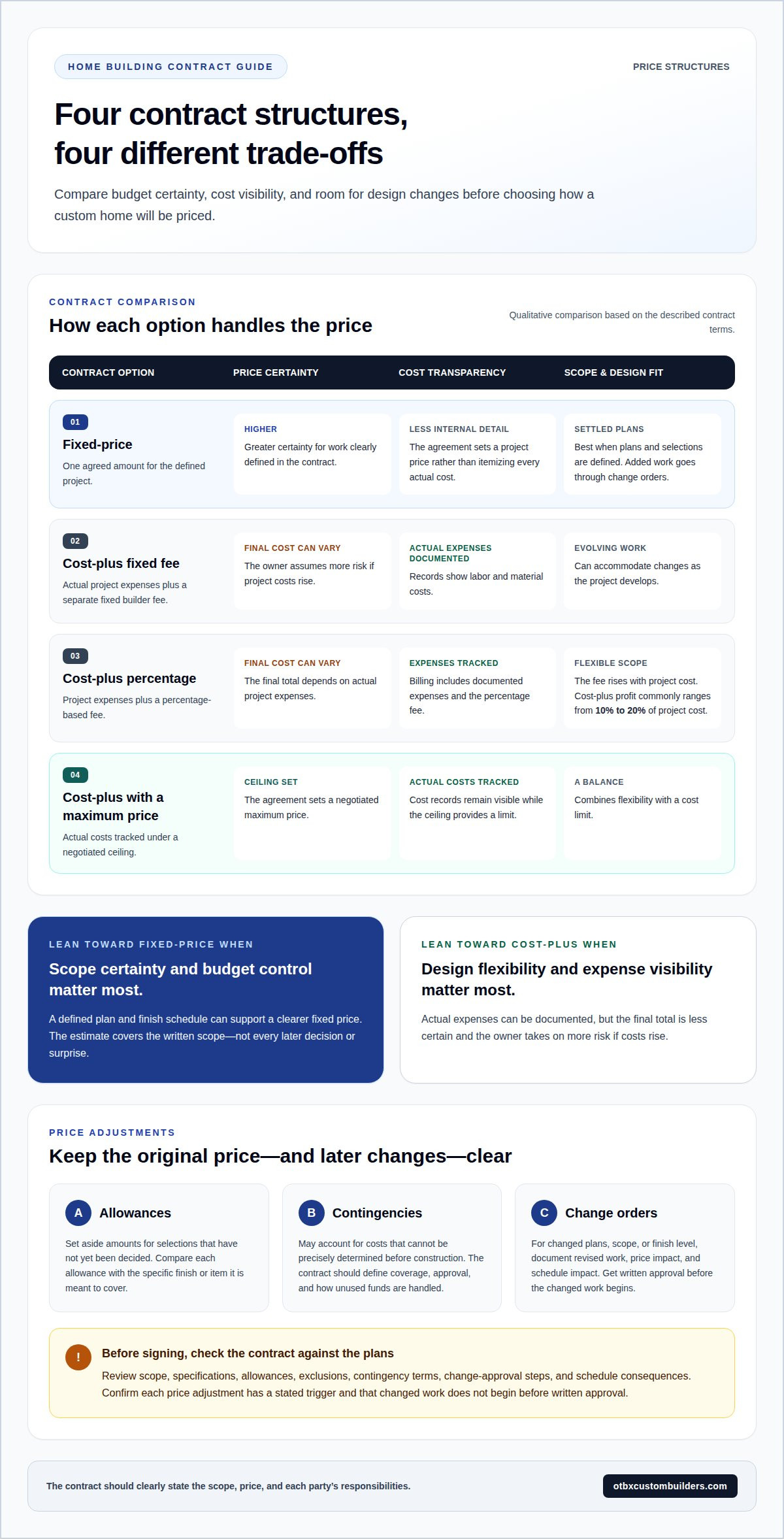
A fixed-price estimate combines costs into one amount for the defined work. Allowances set aside amounts for selections that have not yet been decided.
A payment schedule sets when the owner pays, such as after agreed construction milestones. A deposit is an upfront payment, while later payments follow the schedule. There isn’t one standard payment schedule or deposit amount for every U.S. home-building contract. The agreement should state both clearly, and applicable state requirements can affect deposit limits. Compare these terms separately from the contract’s total cost: they determine when funds are due, not what work the price covers.
A fixed price can combine materials, labor, markup, margins, taxes, and contractor fees into one predetermined amount. The contract scope defines which materials and tasks that amount covers. For example, if the specifications identify a particular finish, the price should reflect that selection. Work or upgrades outside the agreed scope are excluded unless added through the contract’s change process. Allowances cover selected costs that cannot yet be priced precisely, so compare each allowance with the finish or item it is meant to cover.
The contract type changes how the total cost is presented. A fixed-price contract gives one amount for the specified work; cost-plus billing adds actual project expenses and an agreed fee. Under cost-plus, the fee may be a fixed amount or a percentage of project cost. An allowance is different: it reserves an amount for a defined selection rather than pricing every part of the build on a cost-plus basis.
Trade pricing supports the estimate behind a fixed price. Before signing, review a line-by-line breakdown and compare it against plans, specifications, and allowances. A builder may obtain 30 or 40 bids from tradespeople before the homeowner signs, helping price the work from trade quotes. The number of bids alone doesn’t show whether every required task is included. Check that the quoted work aligns with the project documents, and identify any scope gaps before treating the amount as predictable.
A fixed-price contract sets an agreed amount upfront, which can make household budgeting more predictable. Its main advantage is clearer exposure to the price for the defined scope. That certainty has limits: allowances, approved changes, and contract clauses can affect the final amount. Whether a fixed price amounts to a guaranteed final cost depends on what the agreement includes and how it handles adjustments.
There’s a trade-off in the builder’s estimate. A fixed-price quote may account for the builder’s risk of overruns, so its initial amount may be higher than a cost-plus estimate. If actual costs come in below the agreed price, the homeowner typically doesn’t receive the savings unless the contract says otherwise. If costs exceed the estimate, the builder may absorb them, which can reduce the builder’s profit.
Cost-plus can give owners more visibility into actual bills and flexibility as plans develop, but the owner carries more risk if project costs rise. With a percentage-based fee, the builder’s fee is calculated as a percentage of total project cost, so increases can raise both expenses and the fee. A fixed-fee cost-plus agreement works differently: the negotiated fee stays the same even if project costs change.
Fixed pricing also creates an incentive to control costs, but that pressure needs oversight. Cutting corners or concealing defects would undermine the value of a lower-cost approach. Homeowners can address this concern by requiring periodic construction inspections and setting clear quality expectations in the contract. Cost-plus offers more direct visibility into expenses, while fixed-price offers clearer pricing for defined work. Neither structure alone proves workmanship quality.
Use the decision this way: choose fixed-price when the plans are stable and upfront budget certainty matters most. Consider cost-plus when scope remains open and expense visibility matters more, while recognizing the greater exposure to overruns. For a custom home, discuss your home-building plans before settling on the contract structure, so scope and priorities can guide the comparison.
OTBX Custom Builders, LLC builds new homes, including custom and stick-built homes, for owners ready to turn their plans into a defined construction scope. If you are comparing fixed-price and cost-plus terms, bring your priorities for layout, materials, and budget certainty into the early planning conversation. Clear drawings and specifications give the estimate a stronger foundation and help identify decisions that could later affect scope or cost.
OTBX Custom Builders, LLC also handles dock construction and repair, which may be relevant when a home project includes waterfront structures. Understanding what is a fixed-price home building contract depends on how settled the plans are and how you want costs documented. Contact OTBX Custom Builders, LLC to discuss your new-home plans and the construction approach that fits them.
The practical question isn’t only what a fixed-price home building contract is, but whether its written scope reflects the home you intend to build. Before moving forward, gather your plans, preferred materials, and unresolved selections. Use them to identify which decisions belong in the original scope and which could change it later.
That preparation gives you a stronger basis for discussing contract terms and construction priorities. OTBX Custom Builders, LLC offers New Home Construction, including custom and stick-built homes, for owners ready to develop a project around their plans. A focused conversation can connect your design choices with the scope and pricing structure you’re considering.
Contact OTBX Custom Builders, LLC to discuss your home-building plans. A clear next step can make the path from concept to construction feel more manageable.
A fixed-price home-building contract sets one agreed price for the work described in the agreement. The estimate relies on the project’s scope, materials, labor, and other costs. For example, plans and a finish schedule help distinguish included selections from later upgrades. Read the scope alongside the drawings, specifications, and exclusions so the price has a clear written basis.
Allowances and provisional sums reserve estimated amounts for items or work that can’t be priced precisely when the contract is prepared. An allowance might cover a fixture selection; a provisional sum may cover work whose extent is still uncertain. The contract should identify each item, how its budget is treated, and how any difference from actual cost changes the amount due. These terms are not automatically interchangeable, so follow the contract’s definitions.
For work covered by an unchanged fixed-price scope, a later increase doesn’t automatically change the agreed amount. The result depends on the contract’s adjustment language. An escalation clause can allow upward adjustments for specified work when cost conditions change, according to the Internal Revenue Service. For example, the clause may identify affected materials and explain how a documented increase changes the contract price.
A variation can add cost when it changes the agreed work, such as replacing a specified finish with a higher-cost selection. Additional work generally requires an approved change order that records the scope and price adjustment. Depending on the contract’s wording, an unforeseen site condition may be handled through a contingency or an adjustment clause. Compare the proposed extra with the original scope before approving it.
A fixed-price contract gives the owner an agreed amount for defined work, while cost-plus billing adds actual project expenses and a separate builder fee. That fee may be a negotiated fixed amount or a percentage of project cost. For example, cost-plus invoices can rise or fall with documented labor and material expenses; fixed-price billing remains tied to the agreed scope unless contract terms or approved changes adjust it.
Disputes often arise when the written scope doesn’t match the owner’s expectations. An unclear finish description, an allowance that doesn’t cover the selected item, or work started before a change is approved can lead to disagreements about payment. Keep the signed agreement, plans, selection records, change approvals, and invoices together. These documents help show what work was agreed, what changed, and how the parties recorded it.