A builder’s financial trouble can reach a new home through unpaid subcontractors or suppliers. Knowing how to avoid construction liens on new builds…
A builder’s financial trouble can reach a new home through unpaid subcontractors or suppliers. Knowing how to avoid construction liens on new builds starts with tracking who is owed and coordinating payments with written lien releases. In Florida, construction lien claims are governed by Chapter 713 of the Florida Statutes; in Utah, contractors have 180 days from their last day of work to file a mechanics lien.
It’s reasonable to assume that paying the builder settles the bill. But if the builder doesn’t pay a subcontractor or supplier, that party may still pursue a claim against the property, creating a risk of paying twice or facing a title problem.
This guide explains how construction liens work, what owners can do to reduce payment risk, and how Florida and Utah rules differ. You’ll also learn why clear contracts, documented payments, and lien releases matter from the start of a build through final payment.
Florida construction lien claims are governed by Chapter 713 of the Florida Statutes. A lien may arise from unpaid labor, services, or materials used to improve property.
A Notice of Unpaid Balance and Right to File Lien Claim is a New Jersey notice that precedes a residential construction lien claim. It matters because the notice and filing deadlines can affect whether a contractor preserves lien rights. In New Jersey, the notice must be filed with the county clerk within 60 days after the last work. The lien must be filed no later than 120 days after that work. These are not Florida deadlines, so applying them to Florida documents could mislead an owner.
Florida uses a separate project document called the Notice of Commencement. Owners must record it with the Clerk of the Circuit Court before construction begins and post the required copy or affidavit at the site. It identifies the property and owner, describes the owner’s interest, and states whether a payment bond replaces lien rights.
State-specific lien and preliminary-notice deadlines set the time allowed for notices and claims. They matter because missing a statutory deadline can eliminate a claimant’s right to file for nonpayment. Florida’s Notice of Commencement is a project notice, not a universal filing deadline for every lien claim. Utah contractors have 180 days from their last day of work to file a mechanics lien, while New Jersey uses its own notice and lien periods.
Title insurance has a defined limit: it covers claims that predate the policy, but it doesn’t prevent future mechanics liens. A policy therefore doesn’t replace payment records or lien documents created during construction.
In Florida, labor, services, or materials supplied to improve property can support a construction lien claim. That doesn’t mean every unpaid invoice automatically places a lien on a home; the claimant must meet statutory requirements. A Florida lien functions similarly to a mortgage, securing payment tied to the improvement.
The property interest affected also matters. A Florida lien generally attaches only to the interest held by the party who contracted for the improvements. For example, when a lessee contracts for work, the lien generally attaches to the lessee’s leasehold interest. Clear contracts and project documents help show who ordered the work and which property interest may be involved.
Utah contractors have 180 days from their last day of work to file a mechanics lien. Utah identifies its mechanics lien law as Title 38, Chapter 1a. For owners, the key date is the claimant’s last day of work, not simply the date the builder’s agreement was signed or the project began. Keep dated records of site activity, invoices, and payments so the project timeline is clear.
That 180-day period is Utah’s lien-filing deadline, not a universal deadline for every state or every notice. Notice and proof-of-service rules differ. For example, on a New York private project, proof of service must be filed with the county clerk within 35 days after filing the lien. Maryland subcontractors must give owners written notice of intent to claim a lien within 120 days after completing work or providing materials, according to the Maryland General Assembly. These examples show why owners need to identify the property’s state before applying a deadline.
A Notice of Commencement is a Florida project document, not a Utah lien deadline. The owner records it with the Clerk of the Circuit Court and posts the required copy or affidavit at the job site. It identifies the property and owner and states whether a payment bond has been posted in place of lien rights.
If a subcontractor or supplier sends a notice of intent, record its arrival date and the sender’s claimed work, materials, and amount. Compare those details with the agreement, invoices, payment history, and any releases before issuing another payment. Maryland law allows an owner receiving a subcontractor’s lien notice to withhold from the contractor up to the amount owed to that subcontractor, limited by the amount the owner owes under the contract when notice arrives. Utah’s 180-day filing period does not replace careful notice handling or state-specific review.
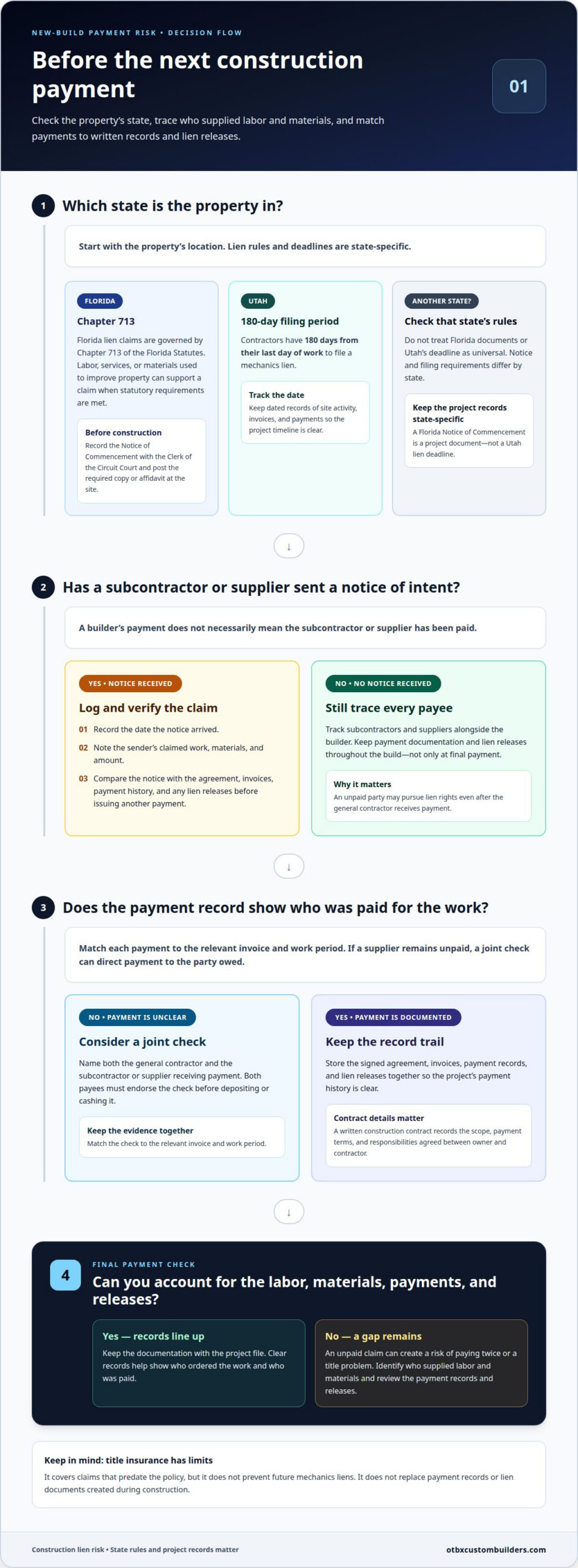
An unpaid subcontractor or supplier may pursue lien rights even after the general contractor receives payment. A construction escrow can release funds against agreed documents, while a title company can coordinate closing records. Neither automatically prevents later claims.
When choosing a licensed and insured contractor, evaluate the credentials and coverage relevant to the work. A clear agreement and reliable payment records help owners understand responsibility if disputes arise. For a Florida project, the construction contract should identify the contractor’s name, address, telephone number, and license number. Keep those details with the signed agreement, invoices, and project records.
A joint check names both the general contractor and the subcontractor or supplier receiving payment. Both payees must endorse it before depositing or cashing it, helping direct payment to the party owed. For example, if a supplier remains unpaid for delivered materials, a joint check can pay that supplier while documenting the contractor’s role. Match the check to the relevant invoice and work period.
A written construction contract records the scope, payment terms, and responsibilities agreed between the owner and contractor. It matters because clear terms give parties a shared record when payment disputes develop. In New Jersey, a construction lien is permitted only when there is a written contract. New Jersey lien arbitration can determine the amount for which a lien may be filed, but it doesn’t finally decide what is owed. Maryland contractors and subcontractors may pursue a breach-of-contract action as an alternative to a mechanics lien.
A lien waiver documents a claimant’s release of lien rights for specified work or payment. Before payment, owners can collect conditional waivers with payment applications; after payment, they can collect unconditional waivers. This sequence ties each release to the funds actually paid. For a Florida progress payment requested before work is complete, obtain partial releases covering workers and materials used to date. Before final payment, request an affidavit identifying unpaid parties and obtain releases from them.
A mechanics’ lien connects a payment claim to property improved by labor or materials. Filing steps and required notices vary by state, so track the project location, work performed, and documents received. Understanding how to avoid construction liens on new builds starts with keeping records that connect each claim to the work it concerns.
Washington State Legislature says a lien against a consumer must be filed within 90 days of work stoppage or delivery of materials. Washington State Legislature also requires lien claimants to mail the property owner a copy of a filed lien within 14 days after filing. These separate requirements make it important to record both the work timeline and when each document arrives.
Maryland follows a different process. According to the Maryland General Assembly, a contractor or subcontractor generally must file a circuit court petition to establish a mechanics’ lien within 180 days after completing work or furnishing materials. The Maryland General Assembly also says a subcontractor must give the property owner written notice of intent to claim a mechanics’ lien within 120 days after completing work or providing materials. A notice and court petition are distinct steps, not substitutes for one another.
A practical way to avoid construction liens on new builds is to connect each payment with the work period, supplier invoices, and any waiver or release. If a lien may be filed, preserve the contract, payment record, notices, and proof of delivery in one project file. An attorney can assess how the applicable lien law treats those documents and deadlines. Make sure each release corresponds to the payment and work it covers; don’t assume it settles every project claim.
A written record of materials delivered and payments made helps clarify which claims remain unresolved. Discuss your new-build plans in a project conversation grounded in clear scope and documentation.
OTBX Custom Builders, LLC builds new homes, including custom and stick-built homes. If you’re planning a build, a clear project scope and organized communication help keep responsibilities and payment records easy to follow. These practices don’t replace the lien rules in the state where the property is located, but they provide a practical foundation for documenting construction work and payments.
Bring your questions about a planned home, project scope, and payment documentation to the conversation. OTBX Custom Builders, LLC can discuss how its new home construction work fits your plans. Contact OTBX Custom Builders, LLC to discuss your project.
Understanding how to avoid construction liens on new builds means treating payment documentation as part of project planning, not paperwork to gather at the end. Set a consistent process for matching each payment to completed work, invoices, and releases. Keep notices and agreements together so the project record shows what was paid, to whom, and for which work.
That discipline gives owners a clearer basis for addressing an unpaid claim and discussing the next payment. Lien rules depend on the property’s state and the project’s circumstances, so legal advice can help when a claim or deadline is disputed. Strong records won’t replace those rules, but they make the payment history easier to understand.
If you’re planning a home build and want to discuss project scope and coordination, contact OTBX Custom Builders, LLC. Start the conversation with a clear picture of your plans and the questions you want addressed. A measured approach can help you move forward with greater clarity and confidence.
A construction lien can arise when a contractor, subcontractor, worker, or supplier goes unpaid for labor, services, or materials used on the property. For example, a general contractor might receive an owner’s payment but leave a lumber supplier’s invoice unpaid. The supplier’s claim can affect the property even though the homeowner paid the general contractor. A lien may cloud the title and complicate a sale or refinance.
Match each payment application to the work period, invoices, and subcontractors or suppliers involved. For example, if a draw includes roofing work, reconcile it with the roofing subcontractor’s billing and material charges. Keep the payment confirmation and corresponding release together. Before final payment, compare the contractor’s unpaid-party affidavit with project invoices and releases so outstanding claims are visible in one record.
A joint check directs payment to both the general contractor and the subcontractor or supplier owed for specific work or materials. Both payees must endorse it before depositing or cashing it. For example, a check naming the builder and a window supplier can help ensure funds for the supplier’s invoice reach that supplier. Keep the invoice and check record together to document the payment’s purpose.
Use a written schedule that connects payments to defined work stages, not vague dates or general progress. Specify the scope, payment conditions, and how changes are approved. In Florida, contract changes should use written change orders signed by both the owner and contractor. For example, document a material substitution and its effect on payment before including the changed work in a later payment application.
Compare the contractor’s legal name and license details on the agreement with the relevant state licensing authority’s records. Request current insurance documentation and confirm that the named business matches the contracting party. To review lien history, search the property’s public records in the county where it is located. Past records can reveal earlier filings, but they don’t establish whether current project invoices have been paid.
There isn’t one deadline for every state; the time limit and required notices depend on the property’s location and project type. Utah contractors have 180 days from their last day of work to file. In Washington, a consumer lien must be filed within 90 days of work stoppage or delivery of materials, according to the Washington State Legislature. Maryland and Florida have separate statutory processes, so identify the applicable state rules before relying on another state’s timeline.