The clearest budget can still change. An open book contractor custom homes approach gives you visibility into project costs as they develop, but it…
The clearest budget can still change. An open book contractor custom homes approach gives you visibility into project costs as they develop, but it doesn’t guarantee a fixed final price. If you’re comparing builder estimates with different levels of detail or trying to understand how allowances and changes affect the total, that distinction matters.
It’s reasonable to expect a builder to explain how costs are tracked, what the contract says about fees and approvals, and how budget changes are reported. Transparency can help you make informed decisions, but it works only when the records and review process are clear from the start.
This article explains how open-book contracting works, which documents and cost updates to ask for, and what to clarify about changes, savings, and overruns. You’ll also see how the approach compares with fixed-price contracting, so you can assess which structure fits your custom-home project and your comfort with cost uncertainty.
A headline estimate can look clear while leaving important questions unanswered: how were costs calculated, what does the builder’s compensation cover, and what happens when the scope changes? For a custom home, the total depends on connected decisions about design, materials, site work, and construction. Read an estimate alongside the assumptions and records behind it.
Open-book contracting means the client and builder agree on access to defined project cost information and supporting records. The phrase “open book contractor custom homes” describes an approach to cost visibility, not a promise that the final price is fixed. Seeing expenses doesn’t, by itself, cap the budget, guarantee savings, or determine who is responsible for overruns. Those responsibilities depend on the contract.
The written terms should say which costs and records you can review, how often they’ll be shared, and how questions will be handled. Records might include supplier bids or invoices, but the contract must specify what is actually available. Open-book accounting provides the broader idea of making financial records accessible. A construction agreement needs to define how that principle applies to the project.
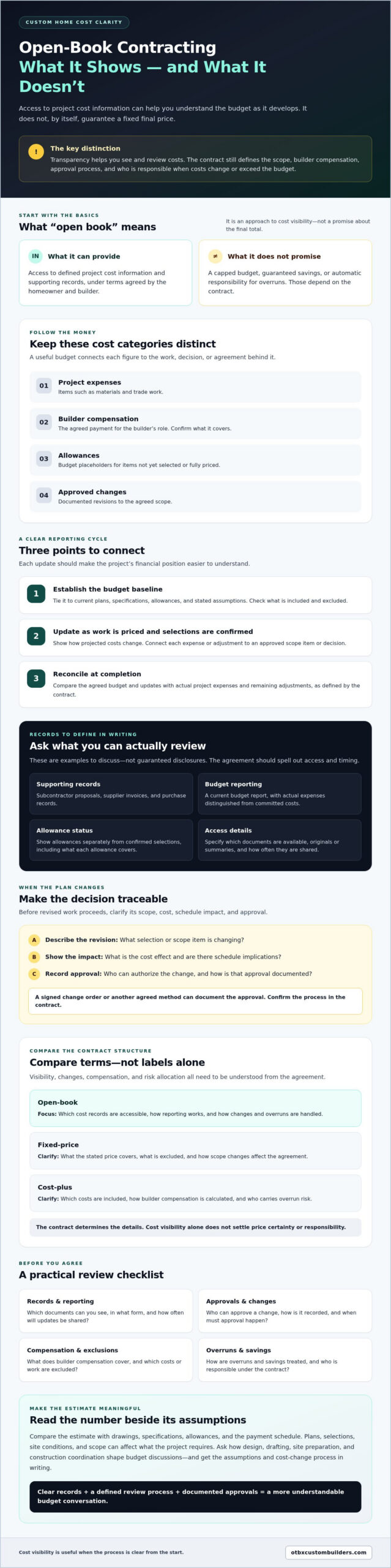
Keep the cost categories distinct. Project expenses cover items such as materials and trade work. Builder compensation is the agreed payment for the builder’s role. Allowances are budget placeholders for items not yet selected or fully priced, while approved changes document revisions to the agreed scope. The contract determines how each category is tracked and treated.
Plans develop, selections become specific, and site conditions may need further investigation. Each can change what the project requires. An early estimate may rely on assumptions about finishes, quantities, or site work. Until those details are confirmed, read the estimate in light of its stated scope and exclusions.
Compare the estimate with the drawings, specifications, allowances, and payment schedule. If a selection exceeds its allowance or a requested revision changes the work, ask how the adjustment will be documented and approved before it proceeds. That makes it easier to connect a cost update to a decision rather than treating it as an unexplained increase.
A custom-home construction guide can provide a broader look at project stages and planning considerations. Whatever building process you consider, ask the contractor to explain the estimate’s assumptions and confirm in writing how cost changes and overruns are handled.
Useful cost reporting follows a sequence. First, the homeowner and builder establish a budget baseline tied to the current plans, specifications, allowances, and stated assumptions. As work is priced and selections are confirmed, the builder updates the estimate to show changes in projected costs. At completion, a final reconciliation compares the agreed budget and updates with actual project expenses and any remaining adjustments, as defined by the contract.
The National Academies’ Open-Book Pricing Practices resource discusses how open-book pricing is applied in construction. For a homeowner, the practical test is whether each update makes the project’s financial position easier to understand. Useful reporting connects each expense to an approved scope item.
Depending on the contract, relevant records may include subcontractor proposals, supplier invoices, purchase records, and a current budget report. These are examples to ask about, not guaranteed disclosures. Confirm in writing which documents you can access, whether you can review originals or summaries, and how often the builder will provide them. The phrase “open book contractor custom homes” has practical meaning only when the contract defines that access.
A clear report should distinguish actual expenses from committed costs, such as work ordered or contracted but not yet invoiced. It should also show allowances separately from confirmed selections, so you can see what remains provisional and what the allowance covers. Ask the builder to identify any assumptions behind the figures.
When a selection or scope revision affects the budget, request written change documentation before the work proceeds. It should describe what is changing, the cost impact, and any schedule implications. Confirm who has authority to approve a change and how approval is recorded, such as through a signed change order or another method specified in the contract.
Review each update against the current drawings, specifications, and approved changes. This helps distinguish a revised estimate from a new expense and gives both parties a shared record of decisions. Reporting supports oversight, but it can’t prevent every unforeseen condition or guarantee that costs won’t change. Ask how the builder will document newly discovered work and explain its budget effect.
As you compare builders, ask to see a sample budget report and discuss how cost updates are handled. You can also review OTBX Custom Builders’ home-building information and ask directly which records, approvals, and reporting practices apply to its contracts.
Contract labels can sound more precise than they are. “Open-book” describes access to cost information, while fixed-price and cost-plus generally describe how the price is determined. These are related but separate questions: pricing method and financial transparency.
An open-book approach may be paired with different pricing structures. The contract, not the label, sets the price basis, disclosure rights, change process, and responsibility for overruns. Compare those terms with the defined scope before deciding which arrangement suits your project.
| Contract approach | Price basis | Cost visibility | Change handling | Risk allocation |
|---|---|---|---|---|
| Fixed-price | A contracted price for defined work | Breakdowns and supporting records vary by agreement | Changes are handled under the contract’s procedures and may affect price | Depends on included work, exclusions, and change terms |
| Cost-plus | Project costs plus an agreed builder compensation method | May include detailed cost access if the agreement provides for it | Changes can affect the costs charged and should be documented | The client may bear more cost variation, subject to contract terms |
| Open-book | Not a price basis by itself | Access to the costs and records specified in the contract | Visibility can help track changes, but approval rules still need to be stated | Access alone does not determine who pays for overruns |
A fixed-price agreement sets a contracted price for a defined scope, subject to its terms and any approved changes. That doesn’t automatically mean every project cost is visible to the homeowner. One builder may provide a detailed breakdown, while another agreement may offer less supporting documentation. Ask what the price includes and review exclusions, allowances, specifications, and the procedure for approving changes.
Generally, cost-plus means project costs are paid on a stated basis, with builder compensation added according to the agreed method. Open-book terms may provide access to the records supporting those costs, but the contract must spell out which costs qualify and how compensation is calculated. Don’t assume the phrase “cost-plus” guarantees a particular level of disclosure.
A guaranteed maximum price may set a contractual cap, but only if the agreement clearly defines the cap, covered scope, exclusions, and treatment of changes or other specified conditions. The name alone doesn’t establish what is protected. Definitions and legal effects can vary, so have qualified counsel review the proposed terms. No structure is universally safer: fit depends on how clearly the work is defined and how the contract allocates cost and change risks.
A transparent label is useful only if the agreement explains what it means in practice. Before signing with an open book contractor custom homes, check that the proposal, contract, drawings, and budget describe the same project. Pay particular attention to what you can review, how decisions are approved, and which costs remain uncertain.
Use this checklist to guide your review:
Then reconcile the estimate with the scope, specifications, allowances, and payment schedule. Check that each allowance identifies what it covers and the assumptions behind it. Confirm that the payment schedule matches the contract’s stated process, and ask how the builder will report any variance. A custom builder guide for avoiding surprises offers related questions to consider as you assess a proposal.
Ask how subcontractor bids, savings, and disputed costs are handled, and what supporting records will be provided. Clarify how unforeseen site conditions and requested scope changes affect the budget and schedule. Get the answers in writing, including who can approve changes and how that approval will be recorded.
Pause if builder compensation is undefined, exclusions are vague, or allowances lack selection assumptions. Verbal approvals, unexplained budget changes, and reports without source documentation also make it harder to trace how the total is changing. These points don’t, by themselves, establish whether a contract is appropriate; they signal questions to resolve before committing.
If any clause remains unclear, ask an independent construction professional or qualified legal counsel to review it. For another perspective on evaluating a custom-home builder, explore OTBX Custom Builders’ home-building information and ask directly which contract terms and cost-reporting practices apply to a project.
A builder’s promise of transparency is only a starting point. Compare how each candidate explains the work, supports budget updates, and handles questions. Ask to review sample documents, such as a project budget, cost report, and change form, with private client information removed. The format should help you follow decisions from the agreed scope through updated costs.
Look beyond labels when assessing an open book contractor custom homes. Ask about comparable project experience, request references, and clarify who will manage communication, explain cost changes, and make or approve decisions. A clear working relationship depends on knowing who is responsible for each step, not just having access to numbers.
Ask how plans, selections, site work, and scope revisions feed into budget discussions. For example, if a plan changes or a finish selection is undecided, the builder should be able to explain which estimate assumptions are affected and how the revision will be tracked. Confirm who coordinates updates and how you’ll receive them.
OTBX Custom Builders describes providing in-house drafting and design-build services, including site preparation and new-home construction. Those capabilities may be relevant to your evaluation, but they don’t establish the company’s contract terms or cost-reporting practices. Ask OTBX directly whether its process includes the reporting, document access, and change approvals you expect.
Request the proposed agreement, defined scope, budget assumptions, a sample report, and the written change procedure. Check that the drawings and specifications align with the estimate, and ask how allowances, exclusions, and builder compensation are described. If an answer affects your budget or responsibilities, ask for it in writing and confirm that it appears in the contract or an attached document.
Before signing, make sure unresolved questions have clear answers. If the agreement uses terms you don’t understand, consider review by qualified legal counsel or an independent construction professional. A careful review can help you see whether the documents support the communication and cost oversight discussed during builder meetings.
Choosing a builder is also choosing a process for resolving questions as the project develops. If you’re considering OTBX for custom-home construction, discuss your custom-home project with OTBX, including your goals and the contract questions you want answered. Confirm its actual open-book practices directly rather than relying on a label or assumption.
Choosing an open book contractor custom homes depends on more than the label. Confirm what records you can review, how often costs are updated, and how fees, allowances, changes, and overruns are handled. Then compare those written terms with the project scope, specifications, and payment schedule. Transparent reporting can support informed decisions, but it doesn’t guarantee a fixed final cost.
OTBX Custom Builders’ company information describes in-house drafting and design-build capabilities, and states that the company is veteran-owned and was founded in 1992. Verify those details, along with whether its contracts include open-book terms and what cost information they provide, directly with the builder.
Bring your project goals and contract questions into an early conversation. Discuss your custom-home project with OTBX and clarify which process and written terms fit your needs. A careful start can make the decisions ahead easier to approach with confidence.
An open-book contractor for custom homes agrees to provide access to specified project cost information and supporting records. The contract should identify what you may review, such as budget reports or supplier and subcontractor records, and how often updates arrive. Open-book describes cost visibility, not a fixed final price or cap. Check the written terms to understand how builder compensation, allowances, changes, and overruns are treated.
No. Cost-plus generally describes a pricing method where project costs are paid on an agreed basis, with builder compensation added according to the contract. Open-book describes access to cost information, so it may accompany a cost-plus arrangement without meaning the same thing. Review the agreement’s definitions, eligible expenses, compensation terms, and record-access rules. The wording matters, and unclear provisions may merit review by qualified legal counsel.
The contract should specify which records are available. Examples to ask about include current budget reports, subcontractor proposals, supplier invoices, and purchase records. Confirm whether you’ll receive copies or summaries, how often reporting is provided, and who can explain variances. Ask the builder to show allowances separately from confirmed selections and to identify committed costs, such as work ordered but not yet invoiced. Access isn’t automatic just because a proposal says “open-book.”
No. Open-book reporting can help you see how costs develop and connect expenses to the project scope, but it doesn’t prevent changes or unforeseen conditions. Selections, revisions, and site discoveries may affect the budget. Ask how the builder will report cost differences, document changes, and obtain approval before revised work proceeds. A contract that clearly allocates cost responsibility helps set expectations, but transparency alone isn’t a budget cap or savings guarantee.
A fixed-price contract sets a contracted price for defined work, subject to its terms and approved changes. Open-book contracting concerns access to cost information, not the price basis. A fixed-price agreement may provide detailed cost records or may not; the contract determines access. Compare the scope, inclusions, exclusions, allowances, and change procedures alongside the price. Neither structure is automatically safer, since the agreement’s terms and project definition affect risk.
Ask which records you can review, how often reports arrive, and who will explain variances. Clarify how builder compensation, allowances, subcontractor bids, savings, disputed costs, and exclusions are defined. Find out how requested changes and unforeseen site conditions are priced, who can approve them, and how approval is documented. If you’re comparing options under the phrase “open book contractor custom homes,” confirm each answer in the proposed agreement, including with OTBX if you’re considering its services.