The contractor label on a proposal won’t tell you who is accountable when design choices and construction costs don’t line up. That’s the practical…
The contractor label on a proposal won’t tell you who is accountable when design choices and construction costs don’t line up. That’s the practical question behind design build vs general contractor: who coordinates the work, and how much responsibility will sit with you?
In a traditional setup, an owner often hires a designer and a general contractor separately. Design-build brings design and construction coordination into one project structure. Neither approach is automatically better. The right fit depends on your priorities, the project’s needs, and how closely you want to manage decisions and communication.
This guide explains how each structure handles design coordination, construction, and the relationship between plans and budget. You’ll compare the trade-offs, learn what to ask prospective teams, and see how to review proposals for clear responsibilities. Use those answers to choose a project structure based on accountability and fit, not just the title a contractor uses.
Design-build combines design and construction coordination within one project structure. A general contractor manages construction, including trades, schedule, and site coordination. The terms describe different things: design-build describes how a project is organized, while general contractor describes a construction role. A general contractor can work as part of a design-build team.
In a traditional arrangement, the owner typically hires an architect or other design professional first. Once the plans are developed, the owner hires a general contractor to build from them. This gives the owner direct relationships with separate professionals, but someone must coordinate communication between the design and construction sides. The design-build project delivery system is commonly contrasted with this design-first, contractor-later approach.
For a custom home, design-build brings design development and construction planning into a coordinated process. The builder, designer, or both may join early discussions about whether the owner’s goals fit the site, plans, and construction approach. The arrangement varies: some firms provide design services directly, while others coordinate with independent professionals. Confirm who provides each service rather than assuming every specialist is in-house.
A general contractor typically manages the construction phase, coordinating trades, work sequencing, schedule, and site activity. The owner may hire the architect or designer separately and serve as the main connection between that professional and the contractor. In other arrangements, the contractor may coordinate design questions with the design team. The agreement and team structure determine who handles that communication.
That distinction matters in the design build vs general contractor decision. A general contractor may be involved under either delivery approach. What changes is how design and construction responsibilities are organized and assigned.
Before choosing based on a company’s label, check what its written scope covers. Confirm who will:
These responsibilities vary by project, agreement, and team. A clear division of duties shows who is accountable for each decision and where you’ll need to stay involved. Focus on the people, coordination process, and documented scope, not the title alone.
The practical difference often shows up in the handoffs. With separate design and construction agreements, the owner may need to carry questions, estimates, and decisions between professionals. In an integrated design-build arrangement, the team has a defined way to coordinate those conversations, but the owner still sets priorities and approves key choices. The Design-Build Institute of America offers resources on design-build practices. The project’s agreements determine the actual roles.
In a design-build team, the designated project lead coordinates information between design and construction. The designer develops documents within their professional scope, while the builder contributes construction input, estimating, and trade coordination as assigned. In an owner-led arrangement, the owner may select the designer and general contractor separately, then help bring their feedback together. In either model, owners make decisions about priorities, selections, and budget trade-offs.
Coordination does not replace professional responsibility. A builder can raise constructability or pricing questions, but design or engineering judgments belong to the qualified professionals engaged for that work. Confirm who prepares, reviews, and approves each type of document.
This responsibility matrix is a starting point, not a substitute for a written scope. Separate professionals give the owner direct selection and communication with each party, but also require more coordination from the owner. An integrated team may provide a clearer route for getting a question to the right person. That structure alone doesn’t guarantee fewer revisions or a faster completion.
Suppose a selected window or room layout needs to change. In design-build, the design and construction leads can review the proposed revision together and explain its design implications and any effects on scope, cost, or schedule. The owner then decides whether to approve it. With separate contracts, the owner may need to collect the designer’s assessment and the contractor’s construction feedback, then reconcile them before making a decision.
In either arrangement, the impact depends on what is changing, when the change is requested, how it’s documented, and what the agreements say. Ask how revisions are submitted, priced, approved, and reflected in the schedule. For an example of a builder offering both residential drafting and custom-home construction, review OTBX’s custom-home design and construction services.
In the design build vs general contractor comparison, the useful question isn’t which label promises the lowest price. It’s whether the proposed scope, assumptions, and decision process give you a clear basis for evaluating the work. A lower initial proposal may leave items unresolved, while an integrated team may raise construction considerations during design. Neither structure guarantees a lower final cost or eliminates changes.
| Factor | Design-build | Separate designer and general contractor |
|---|---|---|
| Coordination | A designated team lead coordinates design and construction discussions. | The owner may connect the designer and contractor or assign coordination another way. |
| Design-team selection | Selection depends on the firm’s structure and agreement; design professionals may be in-house or independent. | The owner typically selects the designer separately from the contractor. |
| Owner involvement | The owner still directs priorities and approves choices, with day-to-day coordination defined by the agreement. | The owner can work directly with separate professionals, but may have more coordination to manage. |
| Construction procurement | The team’s agreement establishes how the builder and trades are selected and engaged. | The contractor is engaged separately, with procurement and trade responsibilities set by that agreement. |
Budget visibility depends on when construction input enters design decisions and how clearly the estimate is documented. A design-build team may discuss construction implications as plans develop. With separate contracts, a contractor may review plans later, unless the parties agree to earlier input. In either case, compare what the estimate includes and excludes, its allowances and assumptions, and how proposed changes are reviewed. The Associated General Contractors of America provides resources on general contracting, but your project’s written scope establishes the terms for your team.
Don’t assume separate contracting is automatically cheaper because professionals are hired individually. Compare proposals on the same scope and consider the time you’ll spend coordinating meetings, clarifying conflicting feedback, and tracking decisions. That effort matters to the practical comparison, even if it doesn’t appear as a line item.
Separate contracts can give you direct selection of each professional. Design-build can provide a more coordinated point of communication. Neither arrangement removes your control over choices, priorities, or approvals, but the agreement determines how you exercise that control. Accountability follows signed scopes, not labels. Before committing, identify who makes recommendations, who approves decisions, and who records changes and their effects on scope or schedule.
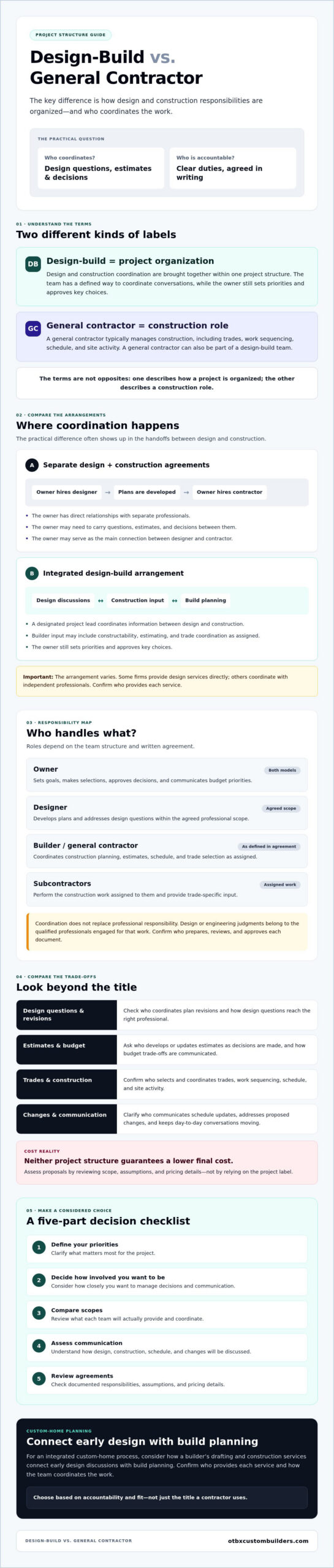
Choose based on how you want decisions, communication, and coordination handled, not on the assumption that one structure is always better. Design-build can suit owners who value coordinated delivery and a clear route for design and construction questions. Hiring a designer and general contractor separately can suit owners who want to select each professional directly and are prepared to manage more coordination.
Use this five-step check before choosing:
Ask each prospective team the same questions: Who prepares the plans and estimates construction work? Who coordinates revisions and communicates construction changes? What’s included, excluded, or still estimated? How are scope changes documented, and who will be your day-to-day contact? Also ask how decisions and approvals are recorded. Specific answers help you understand the working relationship before you sign.
Compare proposals against the same project needs. Check design responsibilities, assumptions, stated owner duties, included work, and exclusions. Look for a clear description of project phases and the decisions required at each point. If proposals differ, ask what accounts for the difference rather than comparing totals without context. For a closer look at assessing transparency, read this open-book contracting explanation.
Your questions can also extend beyond the proposal. The turnkey custom home builder buying guide offers another framework for evaluating a builder, while this custom home builder guide to avoiding surprises can help you consider communication and expectations. These resources can help you prepare, but they don’t replace reviewing the actual agreement.
OTBX Custom Builders, LLC provides residential drafting and custom-home construction as part of its stated process. Review OTBX’s custom-home design and construction approach to consider whether an integrated process fits your priorities.
The right choice in the design build vs general contractor discussion depends on the project structure and the responsibilities you want your team to carry. OTBX Custom Builders, LLC is one option for owners considering a coordinated custom-home process. The company provides custom and new home construction alongside in-house architectural drafting, connecting early design discussions with construction planning without suggesting that every design discipline is handled in-house.
OTBX Custom Builders, LLC describes its Coastal Dream Home Advantage as a process that guides clients from initial concept through construction. The approach connects planning across project phases, while the specific scope and responsibilities should be confirmed for each project. The company’s drafting services include architectural drawings, blueprints, AutoCAD drafting and design, and floor planning design services. Ask which services fit your project and how they relate to construction planning.
For a custom home, early coordination can bring practical construction questions into design discussions as plans take shape. It doesn’t remove the need for clear decisions, a documented scope, or agreement on who handles each task. Assess the process by its actual responsibilities, communication plan, and contract terms, not by its name alone.
Use an initial conversation to explain what you want from the home and how involved you’d like to be as decisions are made. Discuss your design needs, priorities, and expectations for approvals. Then clarify what the proposed scope covers, who is responsible for each phase, how questions and changes will be communicated, and where contract terms spell out those roles.
If you’re still comparing builders, the custom home builder selection guide from OTBX Custom Builders, LLC can help you prepare questions and assess project fit. Use it alongside the proposal and agreement, which should define the actual work and responsibilities. A careful conversation before proceeding gives both sides a clearer starting point.
When you’re ready to discuss your priorities, design needs, and desired level of involvement, discuss your custom-home project with OTBX Custom Builders, LLC. It’s a practical way to learn whether the company’s documented services and process align with what you’re looking for.
The key to the design build vs general contractor decision is understanding who coordinates the work, what each agreement covers, and how involved you want to be. Design-build can suit owners who value coordinated design and construction discussions. Separate contracts can work well for owners who want to choose professionals independently and are prepared to manage more communication. Either way, compare scopes and clarify responsibility before committing.
For a custom home, OTBX Custom Builders, LLC brings custom and new home construction together with in-house architectural drafting. Its stated Coastal Dream Home Advantage process guides clients from initial concept through construction. Drafting services include blueprints and floor planning. Founded in 1992, OTBX Custom Builders, LLC is veteran-owned by Danny and Debbie Spell.
If an integrated process may fit your project, discuss your design needs, desired involvement, and expectations for communication and approvals. Discuss your custom-home project with OTBX Custom Builders, LLC and explore whether its documented services align with your priorities. A clear conversation is a practical next step toward choosing your team with confidence.
Design-build combines design and construction coordination within one project delivery structure. A general contractor typically manages construction, while the owner may hire a designer separately. The terms can overlap because a general contractor can be part of a design-build team. To understand who is responsible for what, review the written scope and agreements. Check who coordinates design questions, prepares estimates, manages construction, and communicates changes rather than relying on a company’s label.
No approach is automatically cheaper. The final budget depends on project scope, design choices, site conditions, contract terms, and how changes are handled. Compare proposals using the same assumptions, inclusions, exclusions, and allowances. Also consider who coordinates the designer and builder, since that work may require your time. An early estimate isn’t a fair comparison if it covers different work or leaves important responsibilities undefined.
Yes. You can hire an architect or designer separately and engage a general contractor to build from the plans. Clear communication matters, especially when construction questions affect the design or require a decision. Agree on who will relay questions and document responses. Some general contractors may provide construction input earlier in the design process, so ask when that input begins and who coordinates communication between the contractor and design professional.
Responsibility depends on the agreement and the type of change. As the owner, you typically make or approve key choices, while the designer and contractor assess implications within their agreed scopes. For example, a layout revision may require design review and input on construction effects. Before work proceeds, clarify who documents the proposed change, who provides any estimate or schedule information, and who has authority to approve it.
Not necessarily. Design-build changes how design and construction input are coordinated, but it doesn’t automatically take decisions away from the owner. Your role in selections, priorities, reviews, and approvals depends on the agreement and project process. Before signing, ask which decisions require your approval, who communicates recommendations, and how choices are recorded. A coordinated team can still involve you closely when expectations and decision points are clear.
Compare proposals by checking whether they cover equivalent work and clearly assign design responsibilities. Review inclusions, exclusions, assumptions, allowances, owner responsibilities, and procedures for changes. Then confirm who will coordinate professionals, serve as your day-to-day contact, and document decisions. Ask about any differences before comparing the proposed totals. A lower initial figure may reflect a narrower scope, so make sure you understand what each proposal does and doesn’t cover.
Design-build may fit if you value coordinated design and construction input and want a clearly defined project team. It isn’t the only sound approach. If selecting independent professionals directly matters to you and you’re prepared to coordinate communication, separate contracts may suit your preferences. Consider your desired involvement, then review the firm’s actual process, scope, and agreement. Ask who handles design questions, how estimates inform decisions, and how changes are documented before choosing.