A loose board may be more than a nuisance, especially if the dock shifts underfoot or its supports look compromised. If you’re searching for dock…
A loose board may be more than a nuisance, especially if the dock shifts underfoot or its supports look compromised. If you’re searching for dock repair near me NC, start by separating surface wear from signs that could affect safe access or structural stability. A faded plank and a leaning piling call for different questions, and a quick patch may miss damage involving the framing, supports, or shoreline connection.
Before using the dock or planning repairs, record what you can safely observe and note where each symptom appears. This checklist will help you distinguish visible warning signs, document changes, and identify when to keep people off the structure until its condition is assessed. It also explains what information about the dock and shoreline can help guide repair planning. The goal is a practical next step based on observations, not guesswork.
A cracked board is easy to spot, but it doesn’t show whether the framing beneath it, a nearby connection, or a support is also weakened. If you’re searching for dock repair near me NC, begin with what you can safely observe from shore or another stable position. Don’t walk onto a damaged-looking section to test it.
Review the visible components in order: deck boards, fasteners, framing, pilings, connections, and shoreline edges. Docks vary in design, so it helps to understand types of docks and their construction when identifying the parts you can see. A worn board may be an isolated issue. A leaning support alongside a shifting frame or widening gaps suggests a pattern that needs a broader assessment by OTBX Custom Builders, LLC.
A visual inspection can identify observable warning signs, but it is not a complete structural diagnosis. Use it to record conditions and decide whether access should be limited, not to determine the full repair scope by appearance alone.
Scan each area without stepping onto questionable decking or reaching over unstable edges. Note the location and visible condition of each issue, and compare it with earlier photos if you have them.
Noticeable movement, uneven sections, loose railings, or gaps between connected parts are reasons to limit access. Several symptoms together, especially across connected components, deserve more attention than one isolated surface defect. Keep people off any section that appears unstable until its condition has been assessed.
A symptom alone can’t confirm the cause or whether the right response is a localized repair or more extensive work. Record its location and appearance, then include nearby supports and shoreline features in the assessment. Looking at those details together can help distinguish surface wear from a pattern involving stability or the dock’s connection to shore.
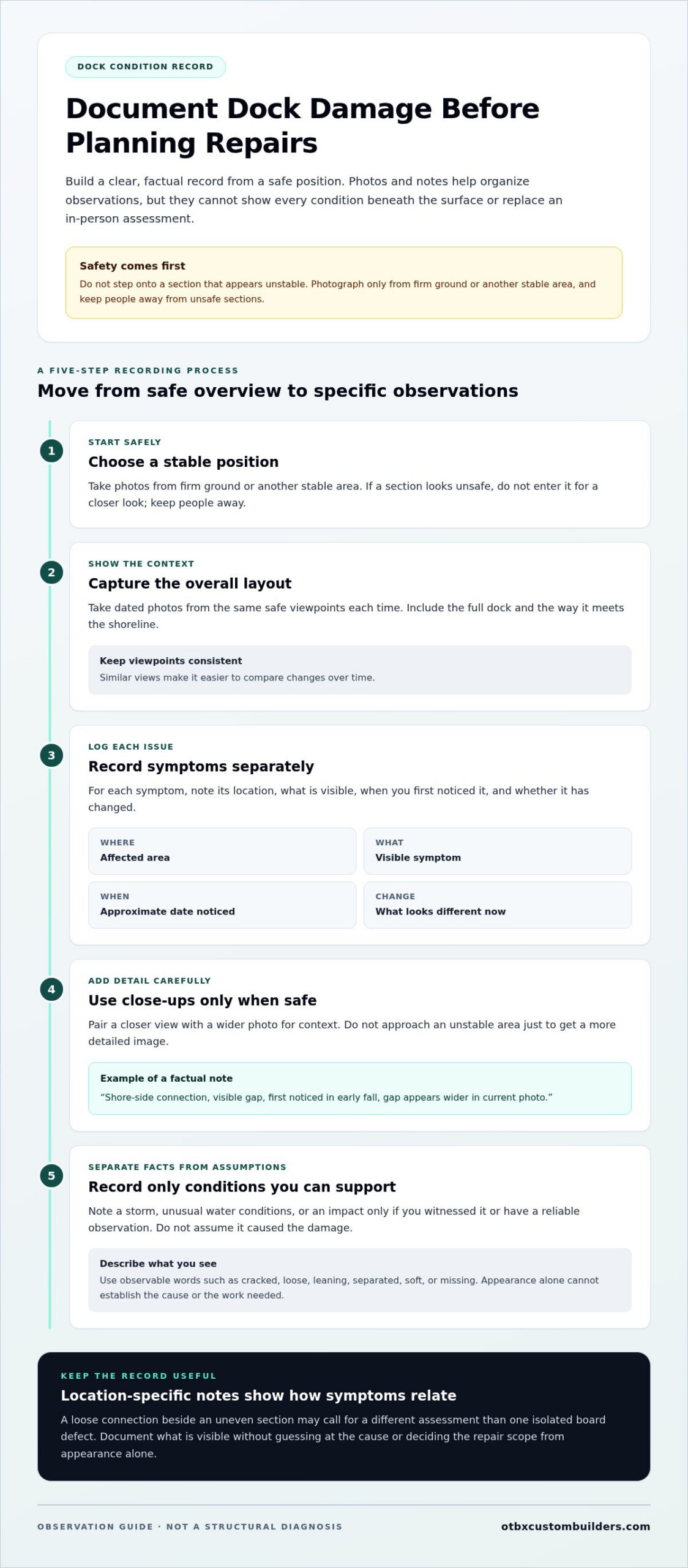
A useful damage record starts from stable ground, not on the dock. If a section appears unstable, don’t step onto it for a closer look. Clear notes and photos help organize your observations, but they can’t show every condition beneath the surface or replace an in-person assessment.
Use this process to create a consistent record:
For each item, write down its location, visible symptom, approximate date noticed, and any changes since then. For example: “Shore-side connection, visible gap, first noticed in early fall, gap appears wider in current photo.” Compare images taken from similar viewpoints, and label estimated measurements as estimates. Consistent notes make it easier to track changes without overstating what you know.
Location-specific notes help show whether symptoms are separate or connected across the dock. A loose connection beside an uneven section may need a different assessment from a single isolated board defect. Keep observations factual so the record supports repair planning rather than guessing at the cause.
Use observable words such as cracked, loose, leaning, separated, soft, or missing. Avoid conclusions like “the piling failed” or “the framing rotted” based only on appearance. A photo may show a leaning support, for example, but it can’t establish why it moved or what work is needed.
For a wider North Carolina perspective, the North Carolina Coastal Federation shares information on dock building codes and resilient construction. Keep that general context separate from your observations because approvals and project requirements depend on the specific work and site. If you’re looking into dock repair near me NC, a clear condition record gives OTBX Custom Builders, LLC a practical starting point for planning dock repairs. Learn about dock repair planning.
A dock’s visible condition can help organize the next assessment, but it can’t settle the repair scope by itself. Look at the pattern, not just the most obvious defect. One damaged component may call for a focused review, while symptoms across connected areas or apparent movement deserve a broader assessment.
| What you observe | What it may suggest | What to document |
|---|---|---|
| One cracked or missing board, with no other visible changes | A localized symptom to assess, not proof that damage is limited to that board | Its position and condition, plus nearby framing and connections visible from a safe place |
| Several loose connections, repeated deck deterioration, or gaps across sections | A pattern involving more than one component that needs a wider assessment | Each affected area and how the symptoms relate across the dock |
| Noticeable movement, shifting, or changes in alignment | A possible stability concern that warrants limiting access and assessing the structure | Where movement or change appears, and how it differs from earlier observations |
This comparison organizes observations; it can’t determine whether a dock needs repair or reconstruction. The same visible symptom can have different implications depending on the structure and site. Water exposure, shoreline conditions, the dock’s age, and prior repairs may all inform an in-person assessment. A small-looking defect might be limited, or it might be one visible part of a wider condition. Don’t assume either from appearance alone.
A single damaged board or one visibly loose connection can be a starting point for a focused assessment. Nearby framing, supports, and connections still matter because they help determine whether the symptom is isolated. Avoid choosing a repair method based only on the visible defect. The appropriate scope depends on the dock’s condition and the project context.
Multiple loose connections, deterioration in repeated sections, or visible changes across the dock can indicate a broader pattern. Recurring symptoms may relate to exposure, materials, past repairs, or underlying structural conditions, but the pattern alone doesn’t identify the cause. If you’re researching dock repair near me NC, dated observations across affected areas can help guide a site-specific assessment without assuming either a small fix or full replacement.
Keep tracking changes from safe viewpoints. Note whether symptoms remain in the same area or appear across connected components, then include that record in repair planning. An assessment can consider the dock and seawall repair on the North Carolina coast together instead of treating each visible defect as a separate problem.
Dock repair planning in North Carolina involves more than the damaged component. Safe access, water and shoreline conditions, the existing structure, and nearby equipment can all affect how a project is assessed. Approval requirements may also depend on the work, shoreline, and governing jurisdiction, so don’t assume one rule applies to every dock.
Gather information about the site before repair planning starts. Weather and access can affect how conditions are observed and what work can be planned safely. Water levels and changes along the shoreline may also provide useful context for visible dock damage.
These details help frame the assessment without assuming a cause or repair method. A dock and its shoreline are connected parts of a waterfront site, so observations beyond the visibly damaged board or connection may matter.
Requirements vary with project scope, location, and shoreline conditions. For a North Carolina project, research current guidance from the North Carolina Division of Coastal Management and the U.S. Army Corps of Engineers where relevant to the site and proposed work. Don’t assume a general rule or paperwork from an older project applies to new work. Verify current requirements for the specific project before planning construction.
For broader context, the companion guides Marine Construction Contractor NC: A Practical Guide to Waterfront Projects and Dock Construction in North Carolina: A Practical Buyer’s Guide address waterfront planning and dock construction. If you’re searching for dock repair near me NC, bring your site notes and available records into the assessment process so repair planning can account for the actual structure and shoreline.
OTBX Custom Builders, LLC provides marine construction and repair for docks, seawalls, and bulkheads. Plan a dock repair project with OTBX Custom Builders, LLC.
Once you’ve noted the visible symptoms, use that record to plan a practical assessment. Keep people off areas that appear unsafe, avoid testing loose or damaged components, and gather information that helps explain what you’ve observed. A thorough review considers the dock’s condition alongside the shoreline and site access, rather than treating one symptom as the whole project.
OTBX Custom Builders, LLC provides marine construction and repair for docks, seawalls, and bulkheads. The work required depends on the observed condition and site context, so repair planning starts with the specific structure rather than a standard solution.
Bring a clear record of what you’ve seen. Helpful details include:
These details provide context for discussing the project. For example, note whether a symptom appears near the shore connection, beside a support, or across several sections. Keep descriptions factual. “Gap appears wider in the latest photo” is more useful than an unverified conclusion about what caused it.
Your notes help frame a review of the dock’s condition and the work that may be needed. The shoreline, access conditions, nearby structures, and relationship between symptoms all contribute to understanding the project. Repair options should follow that review, not assumptions based on a photo or one visible defect.
If you’re searching for dock repair near me NC, take the practical next step: secure unsafe areas, organize your observations, and discuss your dock repair project with OTBX Custom Builders, LLC. Discuss your dock repair project with OTBX.
A visible defect is a starting point, not a complete diagnosis. Note what you can safely observe, photograph changes from consistent viewpoints, and look for patterns across connected parts of the dock. Keep people off areas that appear unstable, and remember that repair approvals can depend on the project and shoreline.
If you searched for dock repair near me NC, use your notes to support a site-specific assessment rather than guessing at the cause or scope. OTBX Custom Builders provides marine construction and repair for docks, seawalls, and bulkheads, and installs and services custom boat lifts. Project planning starts with the observed condition and waterfront context.
Discuss your dock repair project with OTBX and take a practical step toward understanding what work your waterfront structure may need. A careful review of the structure and site can help clarify the next steps.
Look for cracked, missing, warped, or unusually soft-looking boards; loose or corroded fasteners; gaps between connected members; and pilings that appear to lean or shift. Several changes together may call for a broader assessment than one isolated defect. Don’t step onto questionable sections to test them. If you’re searching for dock repair near me NC, record what you can safely see and arrange an assessment to understand conditions beyond the visible surface.
Don’t use areas that appear unstable until they’ve been assessed. Loose boards can create a trip or fall hazard, and a leaning piling may be associated with a change in support or alignment. Appearance alone can’t confirm the cause or extent of the issue. Keep people away from the affected section, and don’t walk on it or try to test its movement. Take photos from a safe position instead.
Water exposure, weather, regular use, material condition, and the surrounding site can all contribute to wear. Fasteners may show corrosion or loosen over time, while boards can crack, warp, or become soft-looking. These signs don’t identify a single cause on their own. Note which materials or connections are affected and whether deterioration appears in one spot or repeats across the dock. An assessment can consider the wider structure and shoreline context.
It depends on the project, shoreline, and governing jurisdiction, so don’t assume one approval rule applies to every repair. Before work is planned, verify current requirements for the specific site and scope. North Carolina’s Division of Coastal Management and the U.S. Army Corps of Engineers may be relevant sources to research, depending on the project. Don’t rely on an old permit or another dock’s approval as a determination for your work.
Start from a safe, stable position and don’t enter a section that appears unstable. Take dated photos from consistent viewpoints, first showing the full dock and shoreline, then capturing visible details from a safe distance. Record each symptom’s location, when you first noticed it, and any change you’ve observed. Include available plans and repair history. Describe what you see, such as “loose” or “separated,” rather than guessing at the cause.
You can’t reliably decide between repair and rebuilding from one visible symptom. A single damaged component may warrant a focused assessment, while movement or related problems across several connected sections may call for a wider review. The dock’s condition, shoreline, age, water exposure, and prior repairs can all inform the decision. An in-person assessment helps define the appropriate scope. Don’t assume a small defect will stay small or that replacement is necessary.
Yes. After a storm, you may notice shifted supports, loose connections, gaps, or uneven sections, but those observations alone don’t prove what caused them. If you directly observed storm conditions or an impact, record that information alongside dated photos and the locations of symptoms. Keep people away from areas that appear unstable. A site-specific assessment can consider the dock and shoreline together before repair needs are determined.